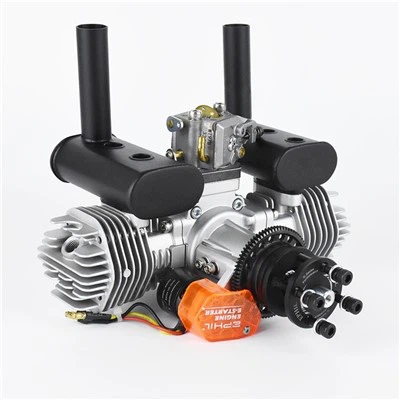
Gasoline engine is a common internal combustion engine. The following is its working principle:
I. Intake stroke
1. Working process
- The intake valve is open and the exhaust valve is closed. The piston moves from the top dead center to the bottom dead center under the drive of the crankshaft. At this time, the volume inside the cylinder gradually increases and the pressure decreases. The mixed gas of air and gasoline is sucked into the cylinder under the action of the pressure difference. Generally speaking, the ideal air-fuel ratio is 14.7 parts of air and 1 part of gasoline.
- In this process, due to the downward movement of the piston, a low-pressure area is formed, so that the mixed gas can enter the cylinder smoothly, preparing for the subsequent combustion process.
II. Compression stroke
1. Working process
- Both the intake and exhaust valves are closed. The piston moves from the bottom dead center to the top dead center under the drive of the crankshaft. At this time, the mixed gas in the cylinder is compressed. As the piston rises, the volume in the cylinder continues to decrease, and the pressure and temperature of the mixed gas continue to increase.
- The purpose of this compression process is to make the mixture reach a suitable state before combustion and improve combustion efficiency. For example, compression can increase the temperature of the mixture to a level sufficient to make the gasoline burn quickly and fully.
III. Power stroke
1. Working process
- When the piston approaches the top dead center, the spark plug generates an electric spark to ignite the compressed mixture. The mixture burns rapidly, producing high-temperature and high-pressure combustion gas. The combustion gas expands in the cylinder, pushing the piston from the top dead center to the bottom dead center. In this process, the energy of the combustion gas is converted into mechanical energy of the piston, which is transmitted to the crankshaft through the connecting rod, causing the crankshaft to rotate and perform external work.
- In the power stroke, the chemical energy released by the combustion of gasoline is converted into mechanical energy, which is a key step for gasoline engines to convert fuel energy into useful work.
IV. Exhaust stroke
1. Working process
- The exhaust valve opens and the intake valve closes. Driven by the crankshaft, the piston moves from the bottom dead center to the top dead center, and the exhaust gas after combustion is discharged from the cylinder.
- The exhaust gas contains carbon dioxide, water vapor and some incompletely burned substances. The exhaust of the exhaust gas prepares for the intake stroke of the next working cycle, ensuring that the cylinder can inhale fresh mixed gas again.
The gasoline engine continuously converts the chemical energy of gasoline into mechanical energy by repeating these four strokes (intake, compression, power, exhaust), thereby providing power for vehicles or other equipment.