

Electronic Parts
EPHIL: Your Trustworthy Electronic Parts Supplier!
EPHIL is the leading supplier of gasoline engines and power systems for model aircraft and drones. Our company was established in 2020. Our main products include aircraft gasoline engines, glow gasoline engines and engine parts. Some models are equipped with larger air, fuel and oil filters, hardened crankshaft journals and self-draining choke carburetors . These engines are widely used in model aircraft, drones and other equipment, with powers ranging from 100 horsepower to 375 horsepower, and are exported to more than 25 countries and regions.
Rich Experienced
Our team consists of several engine engineers, electrical engineers, and product designers. We are good at engine design, production and debugging, and work closely with well-known companies such as Kenncth, Vossen, Westin, ACDelco, Coverking, etc.
High Production
We have our own R&D center and complete production workshop, equipped with professional cylinder processing, quality measurement, CNC, precision lathes and other equipment, which can fully cover the needs of large-volume urgent orders.
Quality Assurance
All the products have registered trademarks in Germany and the United States, invention and design patents in the United States, Japan and China, and have obtained CE, FCC certification and RoHS certificates.
Customized Services
These engines are widely used in remote control aircraft, aircraft models, and UAV models, and support OEM and ODM custom designs to provide versions with different capacities and strokes.
-
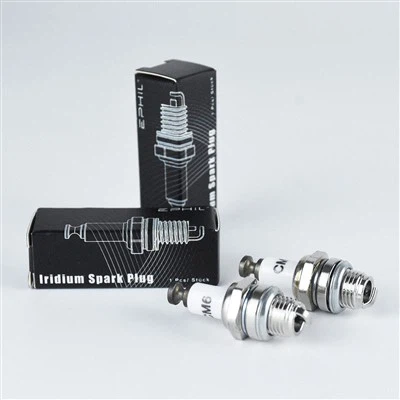
![EPHIL Iridium Spark Plug]()
EPHIL Iridium Spark Plug
EPHIL Iridium Spark Plug Model/Size: CM6 Brand: EPHIL Electrode Material: Iridium Application:Gasoline RC engines Electrode Material The electrodes of common spark plugs are nickel alloy or platinumAdd to Inquiry -
![CDI Electronic Ignition Unit For Single-Cylinder Gas Engine]()
CDI Electronic Ignition Unit For Single-Cylinder Gas Engine
The timing mark is an arbitrary alignment point shared by the engine case and stator plate. It indicates the point at which the top of the piston's travel is equivalent to the trigger point on theAdd to Inquiry -
![E9 Glow Plug For Gasoline Engine]()
E9 Glow Plug For Gasoline Engine
These rpm meters have electronic circuitry, processor, sensor, and LCD or LED readout. These instruments can perform statistical calculations. They can measure the rotation speed of the motor moreAdd to Inquiry -
![Engine Tachometer]()
Engine Tachometer
Dimension: 50×20×16 mm. Voltage: 3V - 16V. Working Current: 10mA. Working Temperature: -10℃ - 65℃Add to Inquiry -
![Hall Effect Engine Ignition Sensor]()
Hall Effect Engine Ignition Sensor
Weight: 7.0gAdd to Inquiry -
![CM-6 Iridium Spark Plug]()
CM-6 Iridium Spark Plug
Weight: 13.5g. Center Electrode Material: IridiumAdd to Inquiry -
![E8 Glow Plug for Gasoline Engine]()
E8 Glow Plug for Gasoline Engine
Model: E8 glow plug. Weight: 3.6g. Voltage: 7.4V-14.8V. Working Current: 500mA-700mAAdd to Inquiry -
![E9 Glow Plug for Gasoline Engine]()
E9 Glow Plug for Gasoline Engine
Model: E9 glow plug. Weight: 3.6g. Voltage: 7.4V-14.8V. Working Current: 500mA-700mAAdd to Inquiry -
![CDI Electronic Ignition Unit for Single-Cylinder Gas Engine]()
CDI Electronic Ignition Unit for Single-Cylinder Gas Engine
Input Voltage: 6V - 14V. Output Voltage: 2kV. Static Electric Current: 30mA. Work Electric Current: 300mA (±3%)Add to Inquiry -
![CDI Electronic Ignition Unit for Twin-Cylinder Gas Engine]()
CDI Electronic Ignition Unit for Twin-Cylinder Gas Engine
Input Voltage: 6V - 14V. Output Voltage: 2kV. Static Electric Current: 30mA. Work Electric Current: 300mA (±3%)Add to Inquiry -
![EPHIL AET Ignition System For Single-Cylinder Glow Plug Engine]()
EPHIL AET Ignition System For Single-Cylinder Glow Plug E...
Model: AET Power System Version G-1.1. Input Voltage: 6V --- 8.4V. Output Voltage: 0V --- 1.6V. Work electric Current: 600 mA --- 700mAAdd to Inquiry -
![EPHIL AET Ignition System For Twin-Cylinder Glow Plug Engine]()
EPHIL AET Ignition System For Twin-Cylinder Glow Plug Engine
Model: AET Power System Version G-1.2. Input Voltage: 6V --- 8.4V. Output Voltage: 0V --- 1.6V. Work electric Current: 600 mA --- 700mAAdd to Inquiry


What is Electronic Parts?
An electronic engine control system is an assembly of electronic and electromechanical components that continuously varies the fuel and spark settings in order to satisfy government exhaust emission and fuel economy regulations. Other electrical components in an automobile include: Switches, Wires, Relays, Controlled motors, Alternators, Battery, Oxygen sensors, Generator. Among them, the spark plug plugs are an important part of internal combustion engines. They are responsible for igniting the fuel and air mixture in the engine, which creates an explosion that powers the engine.
Stable Heat Transfer
The engine spark plugs’ laser-welded ground electrode with alloy inlay is secured to the housing via two legs, helping to facilitate heat transfer to withstand the intense vibrations of engine applications.
Quick Start
These spark plugs are compact and feature an edge-to-edge design that better concentrates spark energy for quick and easy engine starting in any condition, making them suitable for vehicles in a variety of powersports applications.
Durable
Welded using 360-degree continuous laser technology, they provide many times the service life of standard copper spark plugs and prevent pre-ignition and fouling.
Easy to Install
These spark plugs come with pre-gap and nickel-plated threaded ports for quick installation without the need to adjust gap or use anti-seize compound.
Think of spark plugs as the tiniest bolt of lighting. Small but mighty, they spark electricity that ignites an air-fuel mixture deep within your car's engine. In turn, combustion creates the energy required to power your car's pistons, and ultimately, get you to your destination. Here's the step-by-step:
You Turn the Key in the Ignition
When you start your car by pushing the "ignition button" or inserting and turning your key, the starter motor engages, which cranks your engine.
Energy from the Battery Ignites the Plugs
Electricity from the battery travels to an induction coil on your car's combustion engine, which transforms the battery's 12 volts to as much as 45,000 volts before supplying it to the spark plugs.
Sparks Fly
As the induction coil's voltage increases and is transferred to the spark plugs, the plugs ignite the air-fuel mixture inside the combustion chamber — generating a small and controlled explosion in the gap between the plug's electrodes.
Combustion Moves Your Car
Once the air-fuel mixture ignites, a chemical reaction occurs, turning the mixture into an expanded gas or exhaust. The pressure generated by this sudden expansion within the combustion chamber moves your car's pistons, ultimately turning chemical energy into the kinetic energy required to power the engine.
The Cycle Continues
As you continue on your journey, the spark plugs power through this cycle over and over again, helping your car run smoothly till you reach your destination.
Types of Engine Plugs


Copper Spark Plugs
Copper plugs have been around for over a century and have a solid copper core with a nickel alloy electrode. Nickel is softer than platinum or iridium, and thus has a much shorter life. These plugs are usually best for older, low-voltage systems. Because of copper’s high conductivity, some high performance vehicles require them.
Platinum Spark Plugs
Platinum plugs became popular in the late-80’s, when ignition systems began to migrate from distributor-based systems, to coil pack or DIS (wasted spark) systems, which demanded a plug that could withstand the higher-energy, more demanding system. The harder, platinum material lasted longer, as manufacturers made a push to develop spark plugs and antifreeze that lasted upwards of 80-100K miles. Platinum plugs use a platinum disc that is welded to the end of the center electrode, which allows the plug to last longer than a copper plug, retaining its edge better, which means better conductivity. Platinum spark plugs tend to run hotter, preventing fouling and buildup of deposits. It’s important to note that DIS “wasted spark” coil systems operate best on Double Platinum Plugs.
Double Platinum Spark Plugs
Double platinum plugs are the best option for a waste spark system in a distributor ignition. The double-platinum discs in these plugs fire twice that is the most useful for such an ignition system. The second spark gets wasted in other ignition systems.
Double Platinum Spark Plugs
In the early 1990’s, DIS “wasted spark” ignition systems were created, which essentially means that one coil pack controls the firing of two spark plugs in the system. In doing this, both spark plugs that attach to that single coil pack spark at the exact same time – the difference is that one is firing on the compression stroke, and one is firing on the exhaust stroke of the sister-cylinder, which is referred to as a “wasted spark”. To make this even more complicated, one spark plug attached to each coil is positive polarity, while one is reverse polarity. This means that the spark on one plug travels from the center electrode to the side electrode. On the other plug, the spark travels from the side electrode to the center electrode. What this means is that instead of the center electrode wearing as it does in traditional ignition systems, now, the side electrode wears on the plug that is reversed-polarity! This created the need for a double-platinum plug that has a platinum disc on both the center electrode, and the side electrode. This created a plug that is very durable in DIS systems, lasting upwards of 80-100K miles. You don’t want to install single platinum plugs if your owner’s manual recommends a double platinum spark plug. Granted, the plug will work, but will wear prematurely and not perform as well.
Iridium Spark Plugs
Harder than platinum, Iridium plugs came on the market in the mid-2000’s as coil-on-plug systems began to get more popular. Iridium plugs usually feature the smallest diameter center, which can increase efficiency by reducing voltage needed to create a spark. Iridium is also famous for continuing to fire under extreme conditions. If your manual specifies iridium spark plugs, best practice is to absorb the extra cost associated with this rarer metal for best performance.
Double Iridium Spark Plugs
Like double platinum spark plugs, double Iridium spark plugs feature two discs of rare metal for increased performance and durability. Double Iridium Spark Plugs are designed to deliver the firepower necessary under any driving conditions, especially extreme heat or continual high-speeds, and can provide up to 4 times the normal life of service compared to a standard copper spark plug.
Silver Spark Plugs
Among all types of spark plugs, silver is the least common. Featuring a silver-coated electrode tip, these plugs are mostly used in old European motorcycles and performance vehicles. Silver plugs can maintain the same electrode gap throughout their lifetime because this metal is a great conductor of heat and highly resistant to corrosion. They last three times more than the traditional copper plugs and are slightly more expensive than them. They are not better than platinum and iridium plugs but offer a middle-ground between the cheap copper and expensive platinum and iridium.
Factors to Consider When Choose Engine Plugs
Temperature
If a little is good, then more is better… right? Well, like most aspects of performance, this isn’t always the case. When it comes to spark plugs, it’s easy to think that a hotter spark is always better, since the primary goal of a plug is to ignite the fuel at just the right moment, creating the combustion needed to generate the most power. If the tip of the spark plug is too hot, it can cause pre-ignition leading to detonation/knocking, and damage may occur. If it is too cold, electrically conductive deposits may form on the insulator, causing a loss of spark energy or the actual shorting-out of the spark current.
Gap
A known plug gap for your combination (typically .025–.060 inches depending on your application and build) is where we like to begin. Forced induction typically is on the lower side of that range (to prevent spark “blowout”) and naturally aspirated is typically middle or on the higher side of the range.
Material
Many choices are available—here are a few of the more popular ones.
Copper: The traditional racers’ choice, with excellent thermal and electrical conductivity (second only to silver) but a shorter lifespan (typically 20,000 miles).
Platinum: A less popular design for racers, this is often the choice for applications with long intervals between changing plugs. OEMs choose this material for up to 100,000 miles between changes.
Iridium: A more popular design for racers with longer intervals between changing plugs (for those with hard-to-reach plugs, for example). This is also a popular choice because iridium is much harder and stronger than platinum yet is also better at accepting electrical conductivity and dissipating heat than platinum, but not as good as copper or silver.
Silver: Silver is the most expensive (typically) but also one of the most electrically conductive and thermally conductive plug materials available. Surpassing even copper, this metal very easily accepts energy to fire the charge and dissipates the heat away.
Design
The overall design of the plug and electrode is a hotly debated topic. Spending time reading about what plugs people have successfully used on your application will save countless hours in this area—because there’s a huge variety of plug designs to choose from. Single-spark, multi-spark, continual-360-degree designs, and more.
Common Symptoms of the Bad Electronic Parts
Your Check Engine Light Comes on
Worn/failed spark plugs, coil packs, or spark plug wires can trigger your check engine light to come on. In today's cars, if a spark plug fails and can no longer ignite the air-fuel mixture, then the most obvious event should be the check engine light coming on or even flashing. This can cause your engine to misfire and your check engine light to pop on. A flashing engine light could mean that potentially catastrophic misfires are taking place, which could damage the catalytic converter(s). Symptoms of misfiring spark plugs may include rough idling, uneven power when accelerating, and an increase in exhaust emissions.
Your Car as Trouble Starting
Your spark plugs have one of the most important jobs in your vehicle, which is to provide the spark that powers the engine! Old, worn out spark plugs have a harder time creating the spark that actually powers your engine. If your car stalls when you are trying to turn it on, there could be a problem with spark plugs or damaged spark plug wires. The battery is most likely the culprit if your car has no power and won't start at all.
Bad Gas Mileage
If your spark plugs are on their last leg, they’ll take it out on your gas mileage. Worn out spark plugs can increase your vehicle’s fuel consumption because they won’t effectively burn the fuel that goes into the engine, meaning you’ll be shelling out more money on fill-ups. A misfiring spark plug can reduce fuel efficiency by as much as 30%.
The Engine Idles Roughly (and You Can Hear It!).
Typically (hopefully!) your engine probably purrs like a kitten, but turn down your music and take a listen. If you notice that the engine is making rattling, pinging, or knock-like noises, your spark plugs might be to blame.
Your Car Won’t Accelerate Quickly.
You’re probably pretty familiar with how your vehicle handles and drives. If you notice that your car isn’t as responsive as normal, particularly when you’re trying to accelerate, this could be traced back to worn spark plugs. It might be time to have them replaced – no one likes driving a sluggish, fuel-guzzling car.
Benefits of Replacing Engine Engine Plugs
A worn-out spark plug causes engine misfiring. Other problems that might occur include a buck, stall, rough running, or sluggish starting. Your car will perform better and operate at peak efficiency when you change the spark plugs.
Fully functioning spark plugs ensure a fully functional combustion process. Once you achieve this process with your new pieces, you can say goodbye to all the performance issues you were experiencing before. This is because optimal combustion means that all the cylinders in your engine are firing correctly. If they are not, it can cause problems like misfires, hesitations, and decreased fuel economy.
Another advantage of having adequately functioning spark plugs is improved fuel economy. The combustion process will be more efficient, meaning that you will need less fuel to power your vehicle. In addition, replacing old and worn-out spark plugs can also help to improve your mileage since they won’t be working as hard to produce the same level of performance.
If you’ve noticed that your car takes longer to start up or accelerate, it could be due to worn-out spark plugs. When they’re not firing correctly, it can cause these sorts of issues. However, once you replace them with new ones, you should notice a difference in how your car runs.
Finally, replacing the spark plugs can also help to reduce emissions from your vehicle. This is because old and worn-out spark plugs can cause incomplete combustion, which leads to the production of harmful pollutants like carbon monoxide and hydrocarbons. Replacing your spark plugs will help to keep these emissions low and protect the environment.
Certificate


Our Factory


Frequently Asked Questions of Engine Electronic Parts
We're professional electronic parts manufacturers and suppliers in China, specialized in providing high quality customized service, We warmly welcome you to buy or wholesale discount electronic parts in stock here and get free sample from our factory. For price consultation, contact us.
E9 Glow Plug for Gasoline Engine, CM 6 Iridium Spark Plug, CDI Electronic Ignition Unit for Single Cylinder Gas Engine