

Gasoline Engine
EPHIL: Your Trustworthy Gasoline Engine Supplier!
EPHIL is the leading supplier of gasoline engines and power systems for model aircraft and drones. Our company was established in 2020. Our main products include aircraft gasoline engines, glow gasoline engines and engine parts. Some models are equipped with larger air, fuel and oil filters, hardened crankshaft journals and self-draining choke carburetors . These engines are widely used in model aircraft, drones and other equipment, with powers ranging from 100 horsepower to 375 horsepower, and are exported to more than 25 countries and regions.
Rich Experienced
Our team consists of several engine engineers, electrical engineers, and product designers. We are good at engine design, production and debugging, and work closely with well-known companies such as Kenncth, Vossen, Westin, ACDelco, Coverking, etc.
High Production
We have our own R&D center and complete production workshop, equipped with professional cylinder processing, quality measurement, CNC, precision lathes and other equipment, which can fully cover the needs of large-volume urgent orders.
Quality Assurance
All the products have registered trademarks in Germany and the United States, invention and design patents in the United States, Japan and China, and have obtained CE, FCC certification and RoHS certificates.
Customized Services
These engines are widely used in remote control aircraft, aircraft models, and UAV models, and support OEM and ODM custom designs to provide versions with different capacities and strokes.
-
![X-20cc-S Gasoline Engine]()
X-20cc-S Gasoline Engine
EPHIL. X-20CC-S. PROFESSIONAL GASOLINE ENGINE. FOR AIRPLANEAdd to Inquiry -
![X-20cc-S Pro Gasoline Engine]()
X-20cc-S Pro Gasoline Engine
EPHIL. X-20CC-S PRO. PROFESSIONAL GASOLINE ENGINE. FOR AIRPLANEAdd to Inquiry -
![X-20cc-R Gasoline Engine]()
X-20cc-R Gasoline Engine
EPHIL. X-20CC-R. PROFESSIONAL GASOLINE ENGINE. FOR AIRPLANEAdd to Inquiry -
![X-20cc-R Pro Gasoline Engine]()
X-20cc-R Pro Gasoline Engine
EPHIL. X-20CC-R PRO. PROFESSIONAL GASOLINE ENGINE. FOR AIRPLANEAdd to Inquiry -
![X-38cc-S Gasoline Engine]()
X-38cc-S Gasoline Engine
EPHIL. X-38CC-S. PROFESSIONAL GASOLINE ENGINE. FOR AIRPLANEAdd to Inquiry -
![X-38cc-S Pro Gasoline Engine]()
X-38cc-S Pro Gasoline Engine
EPHIL. X-38CC-S PRO. PROFESSIONAL. GASOLINE ENGINE. FOR AIRPLANEAdd to Inquiry -
![X-38cc-R Gasoline Engine]()
X-38cc-R Gasoline Engine
EPHIL. X-38CC-R. PROFESSIONAL GASOLINE ENGINE. FOR AIRPLANEAdd to Inquiry -
![X-38cc-R Pro Gasoline Engine]()
X-38cc-R Pro Gasoline Engine
EPHIL. X-38CC-R PRO. PROFESSIONAL. GASOLINE ENGINE. FOR AIRPLANEAdd to Inquiry -
![X-40cc-T Gasoline Engine]()
X-40cc-T Gasoline Engine
EPHIL. X-40CC-T. PROFESSIONAL GASOLINE ENGINE. FOR AIRPLANEAdd to Inquiry -
![X-40cc-T Pro Gasoline Engine]()
X-40cc-T Pro Gasoline Engine
EPHIL. X-40CC-T PRO. PROFESSIONAL GASOLINE ENGINE. FOR AIRPLANEAdd to Inquiry -
![X-76cc-T Gasoline Engine]()
X-76cc-T Gasoline Engine
EPHIL. X-76CC-T. PROFESSIONAL GASOLINE ENGINE. FOR AIRPLANEAdd to Inquiry -
![X-76cc-T Pro Gasoline Engine]()
X-76cc-T Pro Gasoline Engine
EPHIL. X-76CC-T PRO. PROFESSIONAL GASOLINE ENGINE. FOR AIRPLANEAdd to Inquiry


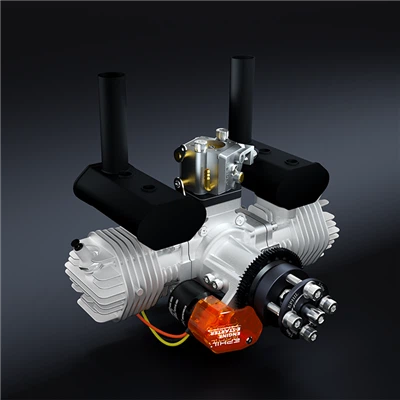


What is Gasoline Engine?
A gasoline engine is a type of internal combustion engine that uses gasoline or a gasoline mixture to generate power. They’re widely used in airplanes, especially in small and light aircraft. A gasoline engine works by compressing a mixture of air and gasoline in a cylinder, then igniting it with a spark plug. The resulting explosion pushes a piston, which turns a crankshaft, which drives a propeller. Gasoline engines have a high power-to-weight ratio, meaning they can produce a lot of power with a small and light engine. But they are less efficient than diesel or jet engines, meaning they consume more fuel and emit more pollutants.
Efficient Cooling
Our gasoline engines have a built-in air cooling system and ventilation radiator, which can quickly reduce the temperature after long-term or high-speed operation to maintain the durability of the motor.
High-powered
With a power of up to 3kw and a rotation speed of up to 3600r/min, they can generate a large amount of power instantly to help you flexibly control the flight process of small aircraft and achieve free switching of speeds.
Durable
These engines are equipped with overhead valves that effectively help reduce carbon deposits and significantly increase fuel savings. Their large-capacity air filters also improve air filtration performance and reduce aircraft wear and tear during operation.
Safe Operation
Our gasoline engines are equipped with an oil alarm. If enough oil is not added before starting, or oil leakage occurs, the engine will automatically shut down to protect the aircraft.
Types of Gasoline Engine


Piston-and-cylinder Engines
Most gasoline engines are of the reciprocating piston-and-cylinder type. Almost all engines of this type follow either the four-stroke cycle or the two-stroke cycle.
Four-stroke Cycle
An internal-combustion engine goes through four strokes: intake, compression, combustion (power), and exhaust. As the piston moves during each stroke, it turns the crankshaft.
Of the different techniques for recovering the power from the combustion process, the most important so far has been the four-stroke cycle. With the inlet valve open, the piston first descends on the intake stroke. An ignitable mixture of gasoline vapour and air is drawn into the cylinder by the partial vacuum thus created. The mixture is compressed as the piston ascends on the compression stroke with both valves closed. As the end of the stroke is approached, the charge is ignited by an electric spark. The power stroke follows, with both valves still closed and the gas pressure, due to the expansion of the burned gas, pressing on the piston head or crown. During the exhaust stroke the ascending piston forces the spent products of combustion through the open exhaust valve. The cycle then repeats itself. Each cycle thus requires four strokes of the piston—intake, compression, power, and exhaust—and two revolutions of the crankshaft.
A disadvantage of the four-stroke cycle is that only half as many power strokes are completed as in the two-stroke cycle and only half as much power can be expected from an engine of a given size at a given operating speed. The four-stroke cycle, however, provides more positive clearing out of exhaust gases (scavenging) and reloading of the cylinders, reducing the loss of fresh charge to the exhaust.
Two-stroke Cycle
In the original two-stroke cycle (as developed in 1878), the compression and power stroke of the four-stroke cycle are carried out without the inlet and exhaust strokes, thus requiring only one revolution of the crankshaft to complete the cycle. The fresh fuel mixture is forced into the cylinder through circumferential ports by a rotary blower (see figure) in the two-stroke-cycle engine of a so-called uniflow type. The exhaust gases pass through poppet valves in the cylinder head that are opened and closed by a cam-follower mechanism. The valves are timed to begin opening toward the end of the power stroke, after the cylinder pressure has dropped appreciably. The inlet ports in the cylinder wall start to uncover after the exhaust opening has decreased the cylinder pressure to the inlet pressure produced by the blower. The exhaust valves are allowed to remain open for a few degrees of crank rotation after the inlet ports have been covered by the rising piston on the compression stroke, thus allowing the persistency of flow to scavenge the cylinder more thoroughly. The compression and power strokes are similar to those of the four-stroke engine.
Such a system is used in many small gasoline engines (e.g., small outboard motors) and for gasoline-powered appliances (e.g., portable electrical generators). Many two-stroke machines are notorious for the noise, carbon emissions, and other forms of air pollution they generate, which has led some municipalities and U.S. states to ban the use of certain devices (e.g., leaf blowers and two-stroke outboard engines). Another disadvantage of two-stroke engines is that the return flow of the gases causes a slight loss of fresh charge through the exhaust ports. Because of this loss, carburetor engines operating on the two-stroke cycle lack the fuel economy of four-stroke engines.
Opposed-piston Engines
The opposed-piston engine also provides uniflow scavenging. This engine has two pistons moving in opposite directions in the same cylinder. Two sets of ports extending entirely around the cylinder bore are located so that one set is covered and uncovered by one piston and the other set is controlled by the second piston. A second crankshaft, to which the upper pistons are attached, is located at the top of the engine, and the two shafts are connected by gears.
Factors Affecting Efficiency of Gasoline Engine
Weight
One of the best ways to increase the fuel efficiency is to reduce down the weight. Which means replacing the heavier parts with the lighter ones .This needs to be done without compromising with the safety,performance and consumer preference.
Replacing the steel components with carbon fibre ones can reduce the weight by approx 60 percent. This 60 percent reduce in weight would decrese the fuel consumption by 30 percent and would cut the emissions of greenhouse gases by 10-20 percent.
Displacement
Displacementis the volume of air the engine can consume in a single revolution. It is generally denoted in litres. The more air the engine can move in, the more fuel it can burn. Thus a small compact engine will be more efficient than a engine.
Compression Ratio
Most gasoline (petrol) engines have the compression ratio calculated purely from the geometry of the mechanical parts(geometriccompression ratio). 10:1 (premium fuel) or 9:1 (regular fuel), with some engines reaching a ratio of 12:1 or more. The greater the compression ratio the more efficient is the engine, in principle . Higher compression-ratio conventional engines in principle need gasoline with higher octane value .High octane value gives the fuel the tendency to burn nearly instantaneously (known as detonation or knock) at high compression conditions.
Fuel Intake
The carburetor system is adapted for the fuel intake. The carburetor contains jets that push the gas into the combustion chambers. The amount of fuel that can flow through these jets depends completely on the amount of air that can be pulled into the carburetor. The main issue with obtaining the best performance using a carburetor is that it can’t monitor the air to fuel ratio for each individual cylinder. In the past years direct injection systems haveincreased the efficiency of the engines equipped with this fueling system up to 35%
Oxygen
If there is not enough oxygen for proper combustion, the fuel will not burn completely and will produce less energy. Relatively, an excessively rich air fuel ratio will increase pollutants from the engine. The fuel burns in three stages. Firstly, the hydrogen burns to form water vapour. Second, carbon burns to carbon monoxide and finally, the carbon monoxide burns to carbon dioxide. This last stage produces most of the power of the engine.
If all of the oxygen is consumed before this stage, engine’s power is reduced.
To increase the amount of oxygen, we need to increase the air intake. One way is through forced induced intake. A compressor can be added to force a larger charge .This can be done by mechanically driven supercharging or exhaust driven turbo charging.
Mechanical Resistance
The automatic transmissions generate more resistance than their manual counterparts. Mechanical resistance usually accounts for about a 15 percent drop in power from what the engine produces to what actually makes. Which means if an engine produces 100 horsepower, then only about 85 of those horses make it to the ground.
An engine has many moving parts that produce friction. Some of these friction forces remain constant while some of these friction losses increase as engine speed increases, such as piston side forces and connecting bearing forces
Synthetic lubricants, light weight materials and tighter manufacturing tolerances can all contribute to less mechanical resistance.
Aerodynamics
At high speeds, and on exceptionally windy days,air resistance(the forces acted upon a moving object by the air also defined asdrag) hasa tremendous effect on the way accelerates, handles and achieves fuel mileage.
Differences between Gas and Diesel Engine
In gas engines, the gasoline fuel and air are compressed together and ignited by a spark stimulated by a spark plug.
In a typical diesel engine, there are no spark plugs. Diesel engines use extreme compression generated by the squeezing of the mixture to create sufficient thermal heat to ensure that the fuel combusts perpetually. For this reason, it is also known as a “compression ignition”.
This is also the fundamental difference between how a gas engine works vs a diesel-engine.
A diesel engine is overall much more efficient and powerful than its gas variant. Diesel is certainly more expensive than gasoline, however, the prices vary across the US, and the difference is not as wide in other states.
Diesel fuel also has more joules of energy per unit. Thus, it is more efficient than gasoline as it provides more energy in the same amount.
The two fuels are also substantially different in terms of the power output. The output of the engines is measured in terms of horsepower and torque. Whereas the horsepower of an engine is strictly the measure of its power, the torque is a measure of the rate at which the engine produces the force on the driveline through the process of twisting.
Whereas both horsepower and torque are responsible for creating a powerful and overall efficient engine, a large amount of horsepower without the equivalent amount of torque to match will cause the vehicle’s acceleration to slow down. Torque is what propels your vehicle forward, and thrusts the engine into motion. This is why large vehicles such as trucks have diesel engines. Powerful engines help vehicles carry huge loads.
However, diesel engines do not rev up as high as other fuel-engines. They create less horsepower, and thus not ideal for fast cars. Diesel engines have high torque, but relatively low horsepower, whereas gasoline engines have more horsepower and less torque.
Vehicles that run on gasoline are overall smoother and provide a better driving experience. You will feel the difference as soon as you step on the accelerator pedal. Diesel vehicles have brisk acceleration.
The most material difference between diesel engines and gasoline engines is that diesel engines run on a compression ignition. A compression ignition is not suitable for a gas engine at all. In fact, it can completely ruin the gas engine. A diesel engine is a lot more reliable as it is built to be tougher and more resistant. These engines are hard-wearing and more durable. They also require less care and maintenance.
A typical diesel engine is also a lot simpler and less complicated than a gas engine since it works without any kind of spark plugs. A diesel engine is also believed to generally last longer than a gas one. Also, the number of miles or hours that diesel engines can efficiently run for, without needing maintenance, is substantially greater.
Certificate


Our Factory


Frequently Asked Questions of Gasoline Engine
We're professional gasoline engine manufacturers and suppliers in China, specialized in providing high quality customized service, We warmly welcome you to buy or wholesale discount gasoline engine in stock here and get free sample from our factory. For price consultation, contact us.
