

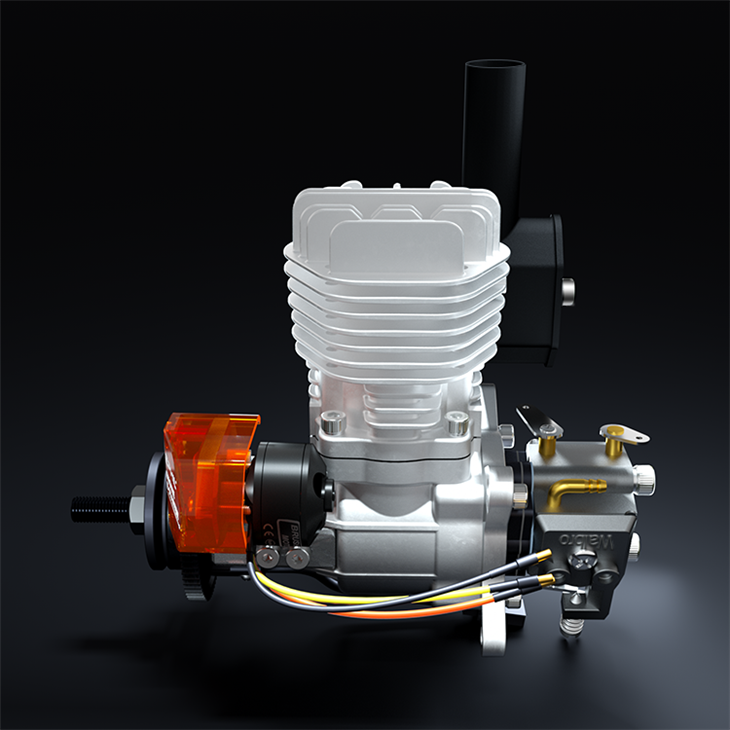
2-Stroke 20cc
EPHIL: Your Trustworthy 2-Stroke Engine Supplier!
EPHIL is the leading supplier of gasoline engines and power systems for model aircraft and drones. Our company was established in 2020. Our main products include aircraft gasoline engines, glow gasoline engines and engine parts. Some models are equipped with larger air, fuel and oil filters, hardened crankshaft journals and self-draining choke carburetors . These engines are widely used in model aircraft, drones and other equipment, with powers ranging from 100 horsepower to 375 horsepower, and are exported to more than 25 countries and regions.
Rich Experienced
Our team consists of several engine engineers, electrical engineers, and product designers. We are good at engine design, production and debugging, and work closely with well-known companies such as Kenncth, Vossen, Westin, ACDelco, Coverking, etc.
High Production
We have our own R&D center and complete production workshop, equipped with professional cylinder processing, quality measurement, CNC, precision lathes and other equipment, which can fully cover the needs of large-volume urgent orders.
Quality Assurance
All the products have registered trademarks in Germany and the United States, invention and design patents in the United States, Japan and China, and have obtained CE, FCC certification and RoHS certificates.
Customized Services
These engines are widely used in remote control aircraft, aircraft models, and UAV models, and support OEM and ODM custom designs to provide versions with different capacities and strokes.
-
![X-20cc-S Gasoline Engine]()
X-20cc-S Gasoline Engine
EPHIL. X-20CC-S. PROFESSIONAL GASOLINE ENGINE. FOR AIRPLANEAdd to Inquiry -
![X-20cc-S Pro Gasoline Engine]()
X-20cc-S Pro Gasoline Engine
EPHIL. X-20CC-S PRO. PROFESSIONAL GASOLINE ENGINE. FOR AIRPLANEAdd to Inquiry -
![X-20cc-R Gasoline Engine]()
X-20cc-R Gasoline Engine
EPHIL. X-20CC-R. PROFESSIONAL GASOLINE ENGINE. FOR AIRPLANEAdd to Inquiry -
![X-20cc-R Pro Gasoline Engine]()
X-20cc-R Pro Gasoline Engine
EPHIL. X-20CC-R PRO. PROFESSIONAL GASOLINE ENGINE. FOR AIRPLANEAdd to Inquiry


A two-stroke (or two-stroke cycle) engine is a type of internal combustion engine that completes a power cycle with two strokes (up and down movements) of the piston during one power cycle, this power cycle being completed in one revolution of the crankshaft. In a two-stroke engine, the end of the combustion stroke and the beginning of the compression stroke happen simultaneously, with the intake and exhaust (or scavenging) functions occurring at the same time. A 20cc 2-stroke engine is a type of internal combustion engine that has a displacement of 20 cc (1.22 cu in). They are often found in smaller, lower power engines such as scooters, dirt bikes, jet skis, and lawn equipment.
Features of 2-Stroke Engine
Efficient Exhaust
Our 2-stroke 20cc engines feature carbs, reed valves, dual-window pistons, and a new class of high-end exhaust for fast, thorough exhaust cooling operation.
Smooth Operation
These engines feature a one-piece cylinder and cylinder head design that reduces operating temperatures, increases load-bearing capacity, and increases power output across the rpm range.
Durable Components
Their components, such as the lined power storage tank, are made of alloys as well as steel and are heat treated to increase hardness, effectively preventing rust and distortion during long-term use.
Balanced Structure
The internal components of these engines are connected by stainless steel hexagonal socket head bolts, and their bearings and the crankcase surrounding the bearings are 60% thicker to provide better balance during operation.

Application of 2-Stroke Engine
Here are the most common applications of the 2-stroke engine
- Small motorcycles, scooters, mopeds, and dirt bikes
- Personal watercraft (jet skis)
- Outboard boat motors for smaller vessels
- Chainsaws, weed trimmers, and leaf blowers
- Snowmobiles
- Lawnmowers
- Larger engines for motor boats and ship propulsion
- Model airplanes and remote-controlled vehicles
- Portable generators and pumps
- Some off-road and racing vehicles for their power-to-weight ratio
Types of 2-Stroke Engine
Piston-Controlled Inlet Port
The piston port is the simplest of designs and the most common in small two-stroke engines. All functions are controlled solely by the piston covering and uncovering the ports as they move up and down in the cylinder. In the 1970s, Yamaha worked out some basic principles for this system. They found that, in general, widening an exhaust port increases the power by the same amount as raising the port, but the power band does not narrow as it does when the port is raised.
Reed Inlet Valve
The reed valve is a simple but highly effective form of check valve commonly fitted in the intake tract of the piston-controlled port. It allows the asymmetric intake of the fuel charge, improving power and economy while widening the power band. Such valves are widely used in motorcycles, ATVs, and marine outboard engines.
Rotary Inlet Valve
The intake pathway is opened and closed by a rotating member. A familiar type sometimes seen on small motorcycles is a slotted disk attached to the crankshaft, which covers and uncovers an opening in the end of the crankcase, allowing charge to enter during one portion of the cycle (called a disc valve).
Another form of rotary inlet valve used on two-stroke engines employs two cylindrical members with suitable cutouts arranged to rotate one within the other – the inlet pipe having passage to the crankcase only when the two cutouts coincide.
The crankshaft itself may form one of the members, as in most glow-plug model engines. In another version, the crank disc is arranged to be a close-clearance fit in the crankcase and is provided with a cutout that lines up with an inlet passage in the crankcase wall at the appropriate time.
Cross-Flow Scavenging
In a cross-flow engine, the transfer and exhaust ports are on opposite sides of the cylinder, and a deflector on the top of the piston directs the fresh intake charge into the upper part of the cylinder, pushing the residual exhaust gas down the other side of the deflector and out the exhaust port.
Loop Scavenging
This method of scavenging uses carefully shaped and positioned transfer ports to direct the flow of fresh mixture toward the combustion chamber as it enters the cylinder. The fuel/air mixture strikes the cylinder head, then follows the curvature of the combustion chamber, and then is deflected downward.
This not only prevents the fuel/air mixture from traveling directly out the exhaust port, but also creates swirling turbulence that improves combustion efficiency, power, and economy. Usually, a piston deflector is not required, so this approach has a distinct advantage over the cross-flow scheme.
Uniflow Scavenging
In a uniflow engine, the mixture, or “charge air” in the case of a diesel, enters at one end of the cylinder controlled by the piston and the exhaust exits at the other end controlled by an exhaust valve or piston. The scavenging gas flow is, therefore, in one direction only, hence the name uniflow.
Stepped Piston Engine
The piston of this engine is “top-hat”-shaped; the upper section forms the regular cylinder, and the lower section performs a scavenging function. The units run in pairs, with the lower half of one piston charging an adjacent combustion chamber.
Components of 2-Stroke Engine
The different parts are listed as follows
Piston
The piston moves by the forces generated by the combustion of the gasses. The piston converts this chemical energy into mechanical energy for the crankshaft.
Crankshaft
It is connected to the pistons and converts the reciprocal motion of the pistons into the rotational motion which drives the driving gears.
Connecting Rod
It connects the piston head to the crankshaft.
Inlet Port
It is the opening for fuel and air mixture to come inside the piston chamber.
Exhaust Port
It is the opening for the exhaust fumes which opens during the downstroke.
Spark Plug
Spark plug is the device inside the piston chamber that causes the combustion of the fuel-air mixture.
Advantages and Disadvantages of 2-Stroke Engines
Advantages
Two-stroke engines do not have valves which are easy to construct and lower their weight.
Two-stroke engines fire once every revolution while four-stroke engines fire every other revolution.
Two-stroke engines can work in any position since oil flow is not a concern with any valves to worry about.
Disadvantages
2-stroke engines do not last as long as four-stroke engines; there is no lubrication system in a 2-stroke engine, so parts wear out a lot faster.
2-stroke oil is expensive; you would burn a gallon every 1000 miles if it were in a car
2-stroke engines use more fuel
2-stroke engines produce a lot of pollution, and the way the engine is designed that part of the air/fuel leaks out of the chamber through the exhaust port, which is why you see a small thin film, or sheen, of oil around any two-stroke outboard motor, and this leaking oil is a real mess for the environment. This is the reason why two-stroke engines are used only in applications where the motor is not used very often and a fantastic power-to-weight ratio is important.
Difference Between a 2-Stroke and a 4-Stroke Engine
Embarking on an in-depth exploration, here’s a detailed breakdown of the key differences between 2-stroke and 4-stroke engines


Stroke Cycle
2-Stroke Engine takes two strokes of the piston (one upward and one downward) to complete the four-engine cycles (intake, power, compression, and exhaust).
4-Stroke Engine needs four separate strokes of the piston (2 upward and 2 downward) to complete the 4-engine cycles, alternating between upward and downward movements.
Simplicity
2-Stroke Engine boasts a simplified design with rare moving parts that make them lightweight and easy to maintain.
4-Stroke Engine has a bit more complex/intricate design, featuring extra valves and components to facilitate the 4-stroke process.
Power-to-weight Ratio
2-Stroke Engine has a higher power-to-weight ratio, delivering more power relative to their size and weight.
4-Stroke Engine has a slightly lower power-to-weight ratio due to the extra components but often compensates with enhanced fuel efficiency.
Fueling
2-Stroke Engine uses a mix of oil and gasoline as a fuel, which requires pre-mixed fuel.
4-Stroke Engine uses pure gasoline as a fuel and maintains a separate oil reservoir for lubrication.
Fuel Efficiency
2-Stroke Engine is less fuel efficient due to part of the fuel-air mixture, escaping during the exhaust stroke.
4-Stroke Engine burns fuel completely, making them a more fuel-efficient option. Thus, it results in better mileage compared to vehicles with 2-stroke engines.
Emissions
2-Stroke Engine produces higher emissions that include particulate matter and unburned hydrocarbons.
4-Stroke Engine produces lower emissions and often comes with emission control systems.
Noise and Vibrations
2-Stroke Engines are a bit louder & noisier and generate more vibration due to their rapid power delivery.
4-Stroke Engine operates quieter with reduced vibrations, which ensures smoother operation.
Lubrication
2-Stroke Engine relies mostly on oil mixed with fuel for lubrication, resulting in enhanced wear and tear along with carbon buildup.
4-Stroke Engine is equipped with a dedicated oil system that aids in better lubrication and reduced wear.
Applications
2-Stroke Engine is most commonly used in small power tools, dirt bikes, scooters, and some recreational vehicles.
4-Stroke Engine is employed widely in cars, motorcycles, trucks, generators, boats, and various industrial machinery.
Maintenance of 2-Stroke Gasoline Engine
Check Engine Oil Regularly
Both regular and synthetic oil lubricates all engine parts and keep them running smoothly. The lubrication that engine oil provides helps minimize engine component wear and tear and keeps all dust, dirt, and sediments out of parts they shouldn’t be in. Routine oil change significantly reduces wear and tear!
Professionals recommend checking your oil level at least once a week to ensure you’re not running low. It’ll only take you a few minutes. Recommended oil levels will be contained in your owners manual, and make sure to swap your oil filter when you get an oil change.
Check Your Battery and its Terminals
Batteries are one of the most common problem-inducing components connected to a 2-Stroke engine. When inspecting your vehicle’s battery, there are a few things to consider.
Firstly, check for any corrosion on your battery and its terminals, especially if you’ve noticed diminished power when driving. White, green, or blue powdery material around your battery indicates corrosion. Secondly, keep an eye on the shape of your battery. An overly rounded or bloated battery is overcharged and may need replacing.
Keep an Eye on the Cooling System
The water pump, thermostat, radiator, and coolant all form part of your engine’s cooling system. These engine parts should be checked regularly to ensure they aren’t damaged, dirty, or old. Firstly, when inspecting the cooling system, ensure that there’s ample coolant in the tank. Aim for a 1:1 ratio of concentrated antifreeze and distilled water for a perfect mix when refilling your coolant (or for the recommended ratio in your owners manual.)
You’ll also need to replace the coolant after it’s gotten old. Healthy coolant will retain a bright hue, while a dark, murky, smelly coolant full of debris needs to be changed.
Monitor the Radiator
Your engine’s radiator works to transfer heat generated by the airplane into the atmosphere by circulating it with antifreeze. Without the radiator, your engine would undoubtedly overheat, which could force you into an engine replacement.
Always check this engine component closely for any physical damage or mechanical defects. Be sure to follow general engine safety tips when working on the radiator.
Keep an Eye Out for Leaks
Fluid leaks can be different things, including coolant, transmission fluid, power steering fluid, or a motor oil leak. Leaks are symptomatic of many severe engine issues. If you see a puddle of fluid in your parking spot, there could be an engine problem with your fuel system, fuel injectors, gasket, transmission, cooling system, motor oil seals, or oil pan.
Replace the Fuel Filter
Your fuel filter guards against harmful substances or deposits entering your fuel system — that is your fuel injectors, fuel lines, gas, and so on. In other words, the filter ensures clean gas flows through your car engine.
Consider replacing your fuel filter to keep your combustion chamber, fuel pump, and engine running cleanly for optimal performance.
Certificate


Our Factory


Frequently Asked Questions of 2-Stroke Engine
We're professional 2-stroke 20cc manufacturers and suppliers in China, specialized in providing high quality customized service, We warmly welcome you to buy or wholesale discount 2-stroke 20cc in stock here and get free sample from our factory. For price consultation, contact us.
2 Stroke 20cc, X 20cc R Pro Gasoline Engine, Gasoline Engine